David Hockney (1937-2026) is considered one of the most influential and defining figures in contemporary art. His seven-decade career and prolific oeuvre is characterized by formal invention, an intellectual inquiry into the nature of depiction and perspective, and a sustained commitment to celebrating and portraying the world around him.
Hockney's formal training began at the Bradford School of Art (1953–57), followed by the Royal College of Art in London (1959–62), where he graduated with a Gold Medal distinction and subsequently emerged as one of the seminal talents in the new generation of British artists.
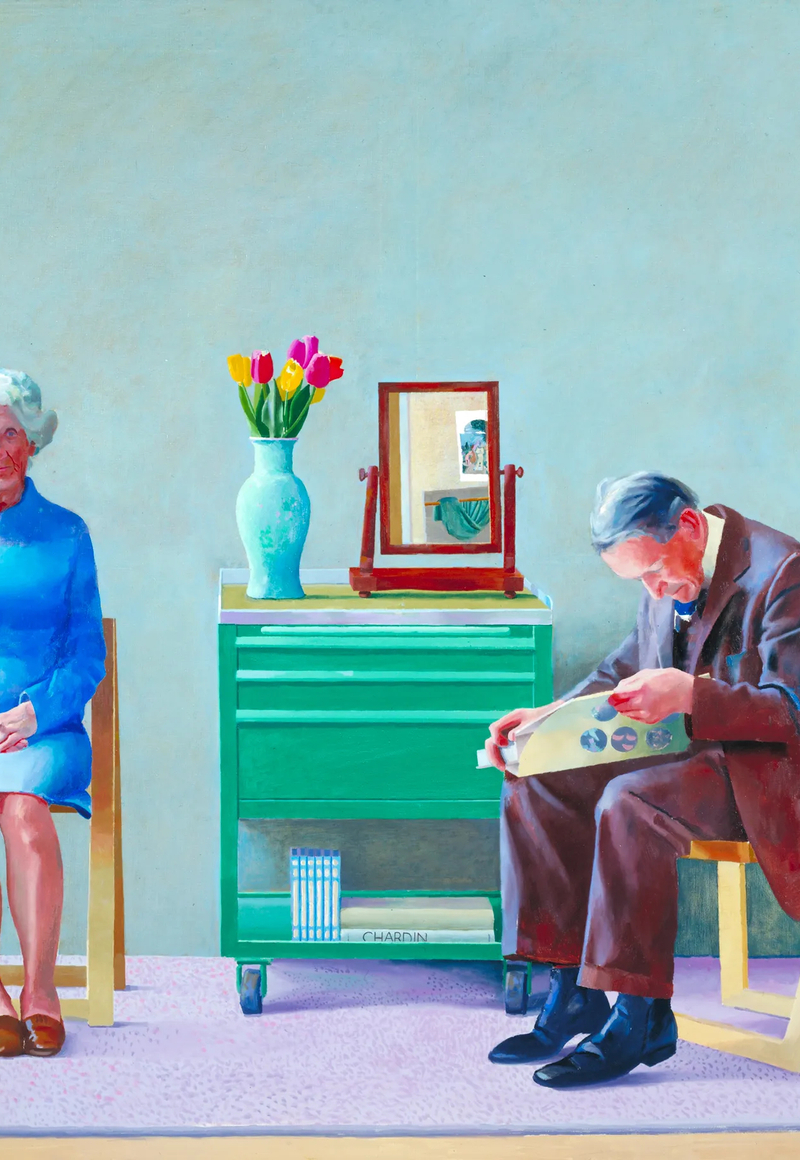
The 1960s saw a pivotal shift in the development of Hockney’s distinct artistic style, away from early experiments with abstract expressionism to figuration and linear mark making, particularly following his move from London to Los Angeles in 1964, where he began documenting the city’s seductive charm from the position of an outsider. This new environment inspired his iconic renderings of the Southern Californian lifestyle (Beverly Hills Housewife, 1966) and the celebrated swimming pool series (A Bigger Splash, 1967) which became widely acclaimed as canonical works. His subject matter frequently explored themes of romantic and sexual intimacy, often leading to large-scale double portraits (Christopher Isherwood and Don Bachardy, 1968; Mr and Mrs Clark and Percy, 1971) as well as the naturalistic style Hockney adopted by utilizing photography as a preparatory medium (Portrait of an Artist (Pool with Two Figures), 1972), which he soon considered too reliant on photorealism.
Concurrently, the mid-1960s marked the start of Hockney’s enduring contributions to opera and theatre. His comprehensive stage designs often involved intense periods of concentration, sometimes lasting more than a year for a single production. Beginning with Alfred Jarry’s Ubu Roi (1966) for London’s Royal Court Theatre, Hockney went on to create a series of landmark productions, including the iconic staging of Igor Stravinsky’s The Rake’s Progress (1975) for Glyndebourne, and Giacomo Puccini’s Turandot (1990) for Los Angeles Opera. Many of his designs, spanning ten opera and ballet productions – are regarded as the definitive visual interpretation and remain in performance rotation decades after their debut.
Hockney’s interest in theatrical space evolved into a broader engagement with figurative abstraction and art-historical references, exemplified by his initial use of ‘reverse perspective’ as a pictorial device in Kerby (After Hogarth) Useful Knowledge, 1975. Hockney’s intellectual curiosity and desire to investigate perception and depiction initiated a long and exploratory relationship with photography and perspective. The 1980s heralded a deep experimentation with photography as Hockney pioneered his photographic collages, employing a Cubist language that combined multiple viewpoints to create two-dimensional images, suggesting the passage of time and challenging the fixed-point perspective inherent to the camera lens and the observer in Western art (Pearblossom Hwy., 11–18th April 1986). As Hockney further explored the semantics of representation across diverse cultural traditions, he synthesized East Asian pictorial conventions in painting with the established customs of European and Western art.
From the late 1990s into the early 2000s, Hockney expanded his practice into the study of art-historical technique, focusing particularly on the optical devices employed by Western artists from the fifteenth century onward. Approaching the subject not only as a scholar but as a master practitioner deeply versed in the physical processes of image-making, Hockney brought a rare technical insight to the analysis of historical works. His ability to critically assess draftsmanship, perspective, light, and mark-making from the perspective of an artist allowed him to identify visual evidence that had often escaped conventional academic interpretation. These investigations culminated in his influential publication Secret Knowledge (2001), which set out a comprehensive theoretical framework concerning the use of optical aids by the Old Masters and further established his significant contribution to the field of art history.
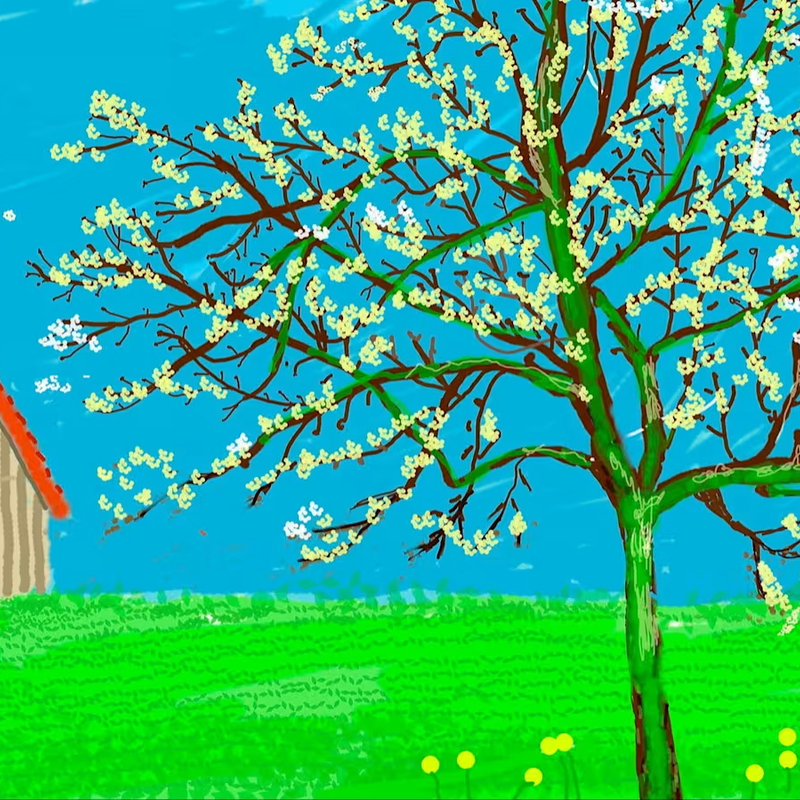
Hockney’s return to Yorkshire in the early 2000s resulted in a renewed dedication to the landscapes of his native land, portrayed in the intensive Midsummer: East Yorkshire watercolour series (2004) and expansive, multi-canvas oil paintings (Bigger Trees near Warter, 2007). The proliferation of evolving digital technology, specifically the iPhone and iPad, became central to Hockney’s practice from 2007 to the present day. He embraces these tools for immediate plein air drawing, resulting in vast series such as The Arrival of Spring in Woldgate, East Yorkshire in 2011 (twenty eleven) and his later iPad frieze A Year In Normandie (2020–2021), the ninety-metre-long panoramic iPad painting inspired by the Bayeux Tapestry during his tenure in his Normandy studio (2019-2023), further demonstrating his commitment to pushing the boundaries of digital media.
After relocating to London in 2023, his work has been celebrated by major international retrospectives, including the pioneering multimedia presentation at London’s Lightroom (2023) and the monumental David Hockney 25 at the Fondation Louis Vuitton in Paris (2025). Exceptional in scale with over 400 works spanning seven decades of groundbreaking creativity, the exhibition offered deeper insights into Hockney’s continual reinvention of artistic media in pursuit of immediacy and a closer connection with both his subjects and himself.
Hockney’s late career has been defined by his unwavering commitment to and vigour for the discipline of painting. Following the Paris retrospective, a show of new paintings in November 2025 at Annely Juda Fine Art in London, Some Very, Very, Very New Paintings Not Yet Shown in Paris, revealed the most developed stage yet of Hockney’s exploration of ‘reverse perspective’ as a pictorial device. In 2026, London’s Serpentine North Gallery exhibited Hockney’s most recent paintings alongside his panoramic iPad frieze, A Year in Normandie, linking Hockney’s profound observations of seasonal change in Normandy with his current studio work in London.
From painting, drawing, printmaking, set design, and photography to evolving media ranging from fax machines to iPads, Hockney synthesizes exceptional draftsmanship with keen observation, a sophisticated understanding of art history coupled with an embrace of modern technology. David Hockney’s enduring oeuvre reflects his underlying enthusiasm for life and investigative curiosity encapsulated by his signature phrase, “Love Life.”
For more information and available works, inquire here.