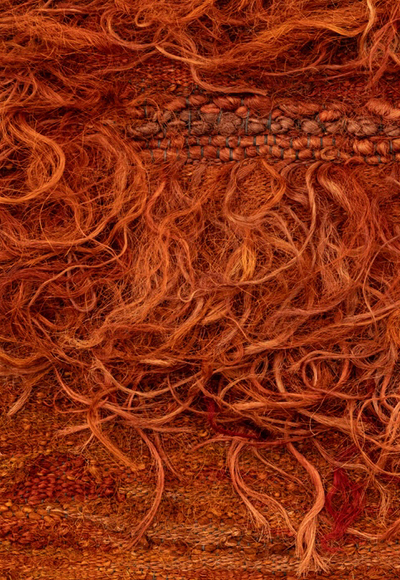
Magdalena Abakanowicz (b. 1930, Poland, d. 2017) gained international recognition as a female artist working in communist Poland, and her influence in fiber arts profoundly expanded the impact of textiles as both material and concept. Throughout Abakanowicz’s adolescence, state repression haunted her artistic output. Her parents were part of the Polish resistance under Nazi occupation, where Hitler’s doctrine of “Art for the Population” (Kunst dem Volk) resulted in the imprisonment and exiling of Poland’s most innovative artists. During Communist rule, when the state defined acceptable modes of artistic production, Abakanowicz was trained in Social Realism at the Academy of Fine Arts in Sopot and the Academy of Fine Arts in Warsaw in the early 1950s.
Weaving presented a unique opportunity to create work less prone to regulations and censorship due to its longstanding association with decorative arts. Mentored by fiber artist Maria Łaszkiewicz, Abakanowicz smuggled her vocational training into a radical critique of authoritarianism and commentary on the human condition. Her work questions the role of the individual amidst the collective, rejecting the Soviet demand for functional, propagandistic art in favor of a primordial mysticism, or, in the artist’s words, “a memory of the most ancient sensations and feelings.”
Abakanowicz worked as a professor at the University of Fine Arts in Poznan, Poland, for twenty-five years, before a 1984 visiting professor position at University of California Los Angeles. After her first solo shows in the United States in the early 1980s, Abakanowicz and her husband Jan Kosmowski founded the Abakanowicz Arts and Culture Charitable Foundation, which, in 2022, began a collaboration with the European League of Institutions of Art to launch a program among fifteen arts universities throughout Ukraine.
Her work can be found in public collections internationally, including the Art Institute of Chicago, Illinois; Centre Georges Pompidou, Paris, France; Metropolitan Museum of Art, New York, New York; Musée d’Art Moderne de la Ville de Paris, France; Museum of Contemporary Art Chicago, Illinois; the Museum of Modern Art, New York, New York; National Gallery of Art, Washington, DC; National Museum of Contemporary Art, Seoul, South Korea; Nasher Sculpture Center, Dallas, Texas; Stedelijk Museum Amsterdam, Netherlands; the Storm King Art Center, Mountainville, New York, and many others.